When Cheap Light Made the Night Longer
Artificial light expanded useful hours, then began competing with sleep.
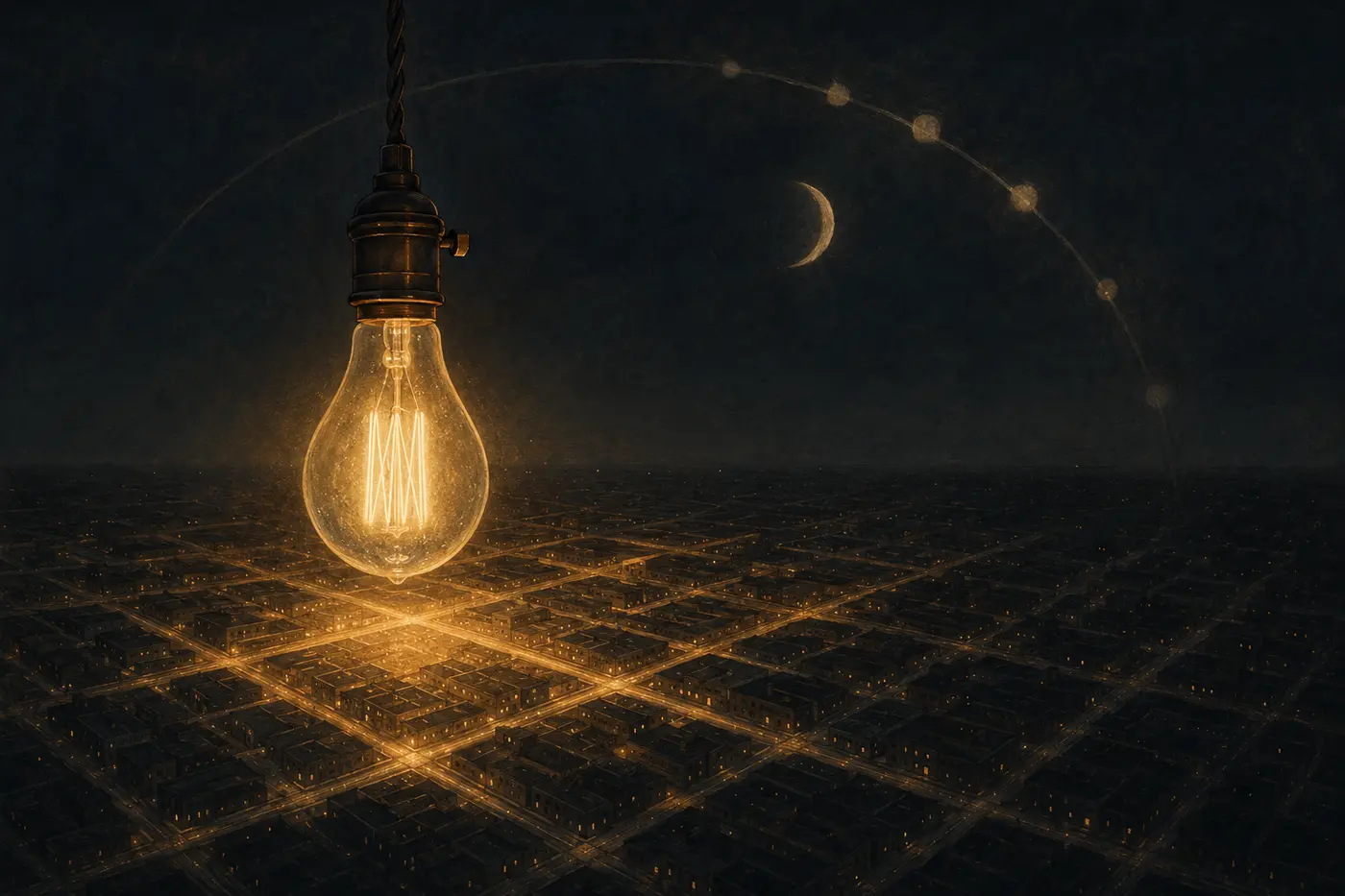
Conceptual editorial image. It illustrates the subject and is not documentary evidence.
Gas and electric lighting made illumination cheaper, safer and easier to distribute at scale.
When illumination was an expense
Before widespread gas and electric lighting, useful artificial light demanded fuel, maintenance and care. Households and businesses made economic choices about how long a room should remain lit. Industrialising cities expanded street lighting, while factories and shops discovered that the working and commercial day could stretch beyond sunset.
Electric systems made illumination cleaner at the point of use, easier to switch and increasingly cheap. Adoption was uneven, and older forms persisted, but the direction was clear: darkness was becoming less able to govern schedules.
Before widespread gas and electric lighting, households purchased illumination through candles, oil, rushlights or fuel burned in a hearth. Brightness was limited, uneven and expensive relative to income. The amount and quality of light available after sunset differed sharply by class, location and season.
People did not simply sleep whenever the sun disappeared. They worked, prayed, visited and celebrated at night. Yet the price and risk of illumination placed a practical boundary around many activities. Darkness was an environmental condition, but access to light was an economic one (Ekirch, 2005).
Gaslight urbanized the evening
Gas lighting spread through streets, factories, theatres and wealthier homes during the nineteenth century. Central production and pipe networks made brighter illumination available at scale. Streets felt more navigable, shops could display goods later and workplaces could extend operating hours.
The technology also introduced fire, explosion, pollution and labour hazards. Every lighting system reorganizes risk as well as visibility. Gas reduced dependence on individual lamps while creating dependence on network infrastructure and professional management.
Electric lighting did not arrive through one bulb or inventor. Generators, distribution systems, meters, standards, capital and municipal permissions were required. As systems expanded and efficiency improved, the cost of useful light fell dramatically over the long term.
A cheaper unit of light changed behaviour because the decision to illuminate one more room or one more hour became easier. Technologies often matter most at the margin: not merely what becomes possible, but what becomes routine because the next use feels almost free.
The night entered industrial planning
Factories could organize shifts with less dependence on daylight, while rail stations, ports and offices extended activity. Artificial light supported productivity and urban safety claims, but it also allowed employers to demand labour at hours previously constrained by darkness.
The benefit and burden were distributed differently. A consumer enjoyed a brighter street; a worker might inherit a night shift. The same infrastructure that widened personal choice could narrow another person’s control over sleep and family time.
Reliable illumination altered how rooms could be used after sunset. Reading, sewing and social life no longer clustered as tightly around a single flame. Buildings incorporated wiring, switches and fixtures, turning light from a movable object into an expected property of the room.
That convenience also created a new baseline. Once homes, streets and businesses were illuminated, darkness could be interpreted as neglect, danger or poverty. Infrastructure changed not only capability but the social meaning of its absence.
Illumination changed education and leisure
Cheaper, safer light expanded the hours available for reading, study, craft and domestic work. Libraries and schools could use evening time, while public entertainment grew around illuminated streets and venues. These gains are easy to overlook because modern readers inherit them as normal.
They were also unequal. Electrification reached communities at different times, and the ability to convert light into education depended on free time, literacy and access to books. Infrastructure creates opportunity; social conditions determine who can use it.
Work, commerce and leisure stretched later into the night, while darkness became less common in cities.
The night became available
Cheap light supported education, production, nightlife, public safety and domestic convenience. It also helped normalise later work and leisure. The body, however, retained circadian systems shaped by cycles of light and darkness. Modern research associates evening light—especially at inappropriate intensity and timing—with delayed sleep and disrupted rhythms.
It would be simplistic to blame the light bulb for modern sleep problems. Work demands, screens, social habits, housing and individual biology all matter. The deeper pattern is that access changed faster than norms for restraint.
For generations, innovation focused on producing more light from less fuel. Once illumination became abundant, a different problem appeared: people and institutions had to decide when darkness was useful. Bedrooms, streets and screens carried light into periods the body had long treated differently.
This reversal is common in successful technologies. Food systems can move from shortage to overconsumption; communications can move from scarce information to attention overload. Policy and habit often lag because institutions remain organized around solving the old scarcity.
Circadian biology did not update with the grid
Human circadian rhythms respond to light and darkness, with timing and wavelength influencing alertness and sleep. Night work can disrupt those rhythms, although health effects vary with schedules, intensity and individual circumstances. The International Agency for Research on Cancer has evaluated night shift work involving circadian disruption as a potential occupational hazard (IARC, 2010).
The responsible conclusion is not that every evening lamp is dangerous. It is that light is biologically active, not merely visual. Design choices about brightness, spectrum and timing can affect people even when they consciously experience the light as convenient.
Outdoor lighting scatters through the atmosphere, producing skyglow that can obscure stars far from the original source. Satellite observations have documented increases in the extent and radiance of artificially lit areas, though measurement methods and the shift toward LEDs complicate interpretation (Kyba et al., 2017).
The loss is cultural and ecological as well as astronomical. Nocturnal species use darkness for navigation, feeding and reproduction. Humans lose a shared view of the night sky that shaped calendars, navigation, story and scientific curiosity.
Efficiency can increase total use
LEDs produce light with far less electricity than older technologies, creating large opportunities for energy savings. Yet lower operating cost can encourage more fixtures, brighter installations and longer hours. The result may reduce the expected savings or increase total exposure even as each lamp becomes efficient.
This rebound effect does not make efficiency pointless. It means engineering performance must be paired with rules and design intentions. A city that replaces bulbs without reconsidering brightness and placement may modernize the equipment while preserving the old assumption that more light is always better.
Street lighting may support visibility and feelings of security, yet more brightness does not automatically reduce crime or accidents. Placement, glare, pedestrian activity and surrounding design matter. Residents can value lighting even when measured outcomes are uncertain because perceived safety changes how they use public space.
Policy should respect that experience while testing specific claims. A lighting programme needs defined outcomes—visibility, traffic safety, accessibility or public confidence—rather than one assumption that every additional lumen is beneficial.
Night work distributed health risk
Hospitals, logistics, manufacturing and emergency services depend on people working when most bodies are prepared to sleep. The benefit is social and widely shared; the physiological and family burden is concentrated among workers and their households.
A fair response includes predictable scheduling, adequate recovery, appropriate lighting, health monitoring and worker voice. Treating night work as an individual lifestyle choice hides the institutional demand that created it.
Astronomical observation once depended mainly on weather and local conditions. Urban skyglow now travels beyond city boundaries, requiring observatories to seek remote sites and communities to create dark-sky protections. A public scientific resource was degraded by countless individually small lighting decisions.
The pattern resembles air and noise pollution: no single lamp owns the combined effect. Governance must therefore operate at the system level through standards for shielding, spectrum, brightness and operating hours.
Brightness became a proxy for progress
Cities celebrated illuminated skylines as evidence of modernity. Businesses used signs to compete for attention, and households associated electric light with comfort and status. Once brightness carried symbolic value, reducing unnecessary light could be portrayed as decline rather than efficiency.
Environmental reform must address this meaning. Technical guidance alone struggles when people believe dimmer streets signal abandonment. Demonstration projects and careful measurement can show that targeted, well-designed light provides better visibility than uncontrolled glare.
The challenge is no longer producing enough light, but deciding when not to use it.
Designing darkness back into life
The practical frontier is no longer maximum illumination. It is appropriate light: enough for safety and work, warmer and dimmer when the day should close, and less spill into bedrooms and ecosystems. Cities also face the environmental cost of light pollution.
A successful technology can become infrastructure before society learns when not to use it. Cheap light expanded freedom. Preserving that gain now requires treating darkness not as failure, but as a resource with biological and ecological value.
Hospitals, transport routes and public spaces require illumination. The practical question is how to deliver the right amount, where and when it is needed. Shielding, warmer spectra, adaptive controls and targeted placement can preserve safety while reducing glare, energy use and unnecessary skyglow.
Good policy should compare outcomes rather than equating brightness with safety. Poorly aimed light can create deep shadows and glare that reduce visibility. The goal is useful vision, not maximum lumens.
Screens made illumination intimate
The electric grid lengthened public night; phones and tablets brought bright, interactive light within centimetres of the face. The device combines illumination with social reward, work demands and endless content, making restraint harder than switching off a passive lamp.
Design responses therefore need more than colour filters. Notification norms, workplace expectations, device-free routines and control over late-night demands affect whether people can reclaim darkness. The problem is partly optical and partly institutional.
As artificial light becomes ubiquitous, genuine darkness becomes scarce and unevenly distributed. Dark-sky parks and carefully designed hotels market an experience that earlier generations received without payment. A public environmental condition has begun to resemble a premium amenity.
The history of cheap light warns against romanticizing the past: darkness also limited education, safety and productive choice. The mature response is not retreat. It is to preserve the enormous benefits of illumination while recovering the ability to turn it off.
Smart lighting can fail intelligently or stupidly
Sensors and adaptive controls can dim empty roads and brighten areas when people approach. They can also create surveillance concerns, maintenance complexity and failure modes in which users lose control. Intelligence should serve a clear lighting purpose rather than becoming a pretext for collecting data.
The best systems degrade safely, publish their operating rules and allow local adjustment. A city should not need a behavioural profile of every pedestrian to provide appropriate light.
Darkness will not return simply because efficient technology exists. Institutions must choose limits, and households must defend periods free from bright screens and demands. The cultural task is to make turning off a sign of good design rather than failure.
Cheap light expanded human freedom. Preserving that achievement now requires a second freedom: the ability to find darkness, sleep and see the night sky without purchasing escape from the systems that illumination created.
Equity belongs in dark-sky policy
Calls to reduce lighting can sound detached from the concerns of people who feel unsafe or whose neighbourhoods have received poor infrastructure. Policies should involve residents, distinguish useful light from waste and ensure savings are not achieved by withdrawing service from lower-income areas.
A just transition protects both darkness and access. It invests in shielding, maintenance and public-space design so communities do not have to choose between stars and safety, sleep and mobility.
Artificial light remains one of civilization’s great practical achievements. It reduced a profound constraint on safety, work, care, education and leisure. Any account that treats darkness as an uncomplicated lost paradise forgets the fires, expense and limits that cheap electricity helped overcome.
The success created a new responsibility because abundance removed an old automatic boundary. When light was costly, households and cities rationed it. When light became cheap, restraint had to become intentional. Bodies, ecosystems and the night sky now depend on choices that price alone no longer forces.
The policy aim is therefore not darkness everywhere. It is fit: enough illumination for the task, directed where needed, timed appropriately and governed with the people affected. A mature lighting system proves its sophistication not by how much darkness it defeats, but by how precisely it knows when light serves no further purpose.
Technologies that remove scarcity often create a new problem of self-limitation.
References
Sources are listed in Harvard author–date format. Links are provided where a stable public record is available.
- Ekìrch, A.R. (2005) At Day’s Close: Night in Times Past. New York: W.W. Norton.
- International Agency for Research on Cancer (2010) Painting, Firefighting, and Shiftwork. IARC Monographs, Volume 98. Lyon: IARC.
- Kyba, C.C.M. et al. (2017) ‘Artificially lit surface of Earth at night increasing in radiance and extent’, Science Advances, 3(11), e1701528. doi:10.1126/sciadv.1701528.